

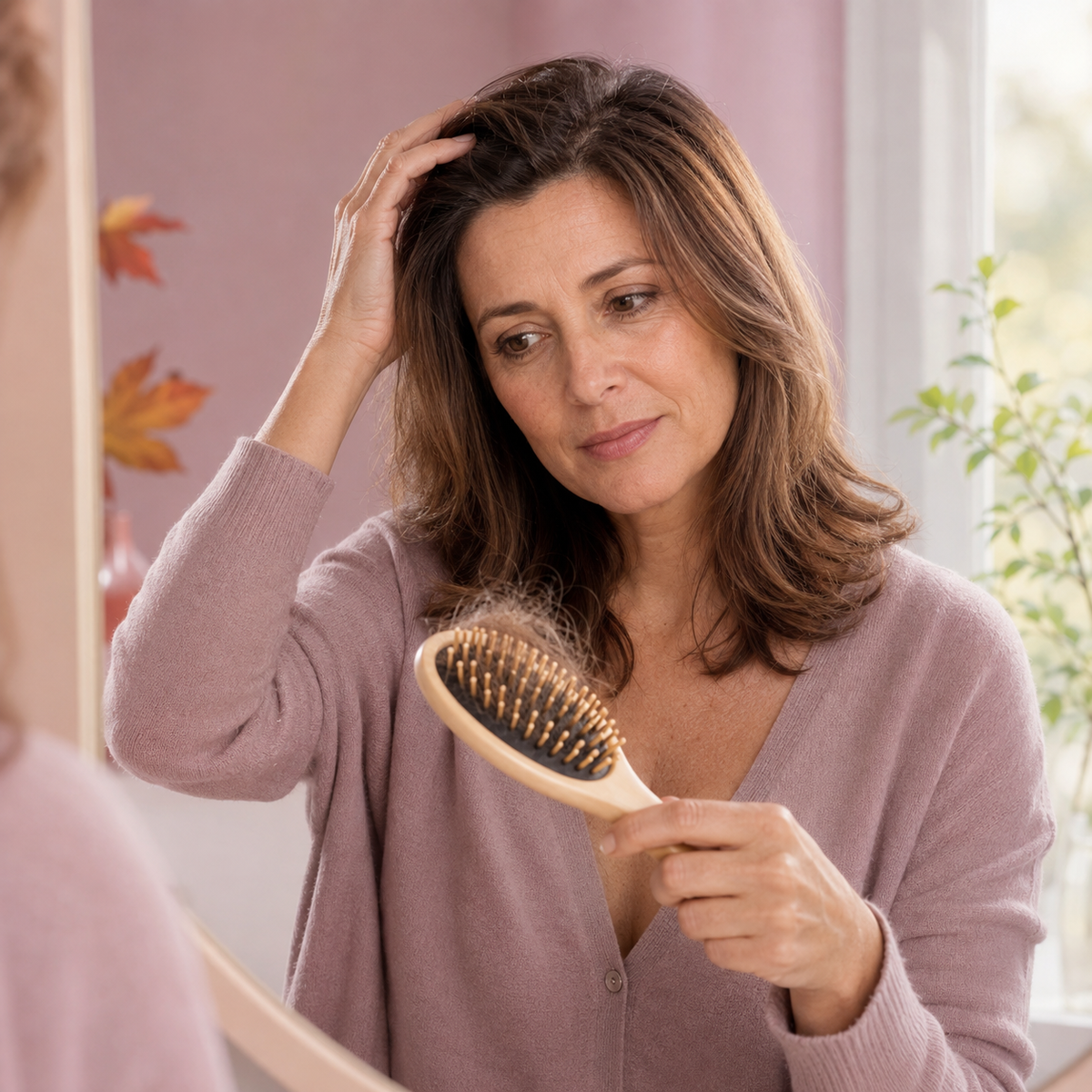
Seasonal shedding: why your hair falls out more at certain times of year
A hairbrush that fills up faster in fall, a bit of shedding again in spring: here's what's really going on, and when to worry.
Noticed more hair in the drain, on your pillow, or in your brush the last few weeks? Before you panic, there's a good chance it's simply your hair cycle following the seasons.
Like the rest of your body, your hair is constantly renewing itself. Every day, dozens of hairs finish their cycle and fall out while others grow back in. At certain times of year, this turnover speeds up for a large portion of your hair all at once, which makes the shedding feel much more noticeable.
Why it happens
The main trigger is light. The amount of daylight affects melatonin, a hormone that plays a role in how long hair stays in its growth phase (the anagen phase). When daylight shifts noticeably, like at the end of summer or the end of winter, a larger share of follicles switch over to the resting phase almost simultaneously, and then to shedding.
There's also a lag to factor in: it usually takes about two to three months between the time a follicle enters its resting phase and the time the hair actually falls out. That's why the most noticeable shedding often shows up a little after the actual change of season, not right on the first day of fall or spring.
The most noticeable
Usually between September and November. This is the after-effect of summer: the strong light and sun exposure had extended the growth phase for a lot of hair, which is now switching over to the resting phase all at once.
More subtle
Usually between March and May. Longer days shift melatonin production again. Shedding is usually less intense than in fall, but follows the same pattern.
hairs lost per day is considered normal, even during seasonal shedding. Hair is living tissue that's constantly renewing itself.
How long it lasts
A typical seasonal shed lasts anywhere from a few weeks to two or three months, then resolves on its own without any special intervention. It's not permanent hair loss: the follicles that went into their resting phase will start producing new hair again, just like before.
When to worry: if the shedding lasts more than six months, if it comes with visible thinning or a widening part, or if it shows up outside of fall and spring for no clear reason, it's worth talking to a hair health professional to rule out another cause (thyroid, a deficiency, major stress, or the start of a more lasting type of hair loss).
How to get through this period
You can't prevent seasonal shedding, but you can avoid making it worse with a poorly cared-for scalp.
A scalp with product buildup tends to trap hair that's already detached at the root, causing it to shed in more noticeable clumps.
The goal is to clear away buildup without stripping the scalp, so it keeps its natural balance.
Heat styling, coloring, and tight manipulation all add extra strain to follicles that are already in transition.
Some people do a two-to-three-month nutritional support treatment twice a year, around the seasonal changes. It's not necessary for everyone, but it can help if your hair tends to be more fragile.
In summary
Seasonal shedding is a natural phenomenon tied to light and the hair cycle, not a problem in itself. It mostly shows up in fall, a bit in spring, and usually resolves within two to three months. Keeping your scalp clean and well cared for helps you get through this period without making it worse. If shedding lasts beyond six months or comes with other signs, a consultation can help rule out a different cause and put your mind at ease.
Gisèle xx

